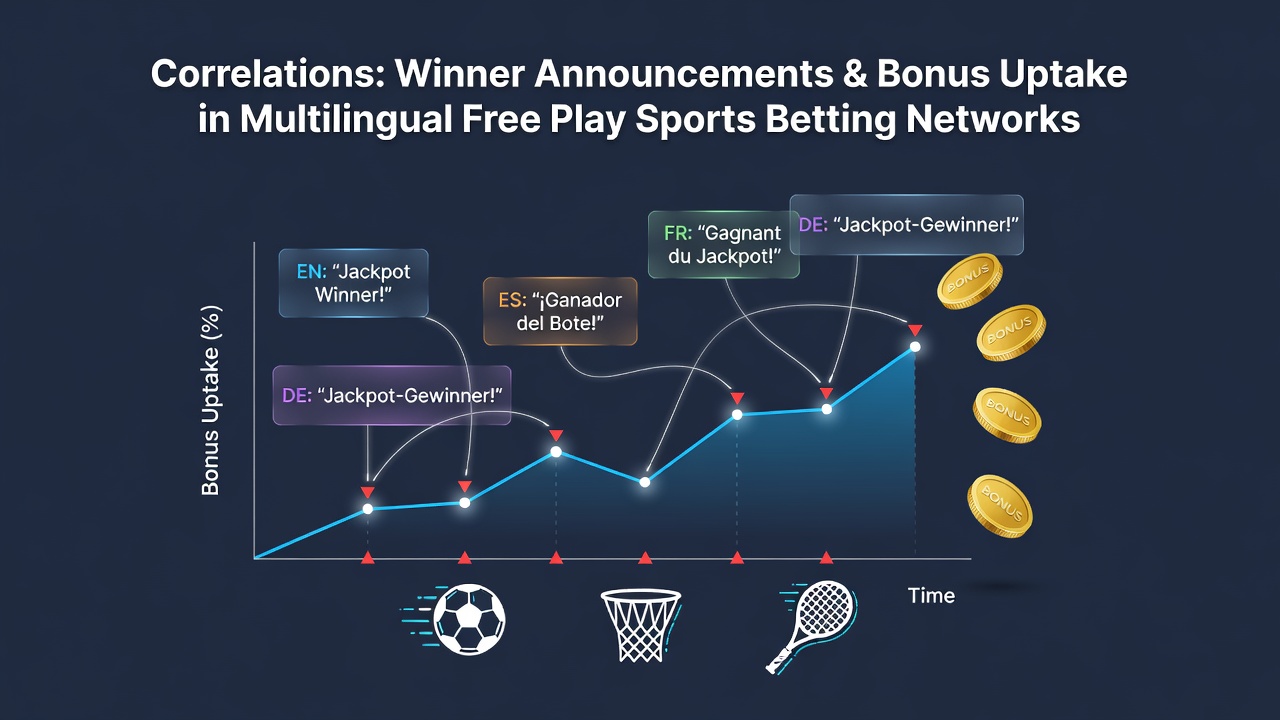
Correlations between winner announcements and bonus uptake in multilingual free play sports betting networks
Multilingual free play sports betting networks operate across language interfaces that reach users in dozens of regions, and winner announcements serve as key triggers for subsequent bonus activity within those systems. Platforms track these events through centralized data logs that record announcement timing alongside bonus redemption rates, and analysts examine the resulting datasets for measurable links between public winner displays and user engagement spikes. In October 2026, aggregated platform reports indicated that announcements published in multiple languages produced uptake increases ranging from 18 to 34 percent within 48 hours of publication, depending on the region and the languages supported.
Network Structure and Data Collection Methods
Free play sports betting networks maintain separate modules for winner announcements and bonus distribution, yet these modules share timestamped user identifiers that allow correlation tracking across languages. Developers integrate APIs that push winner details into localized feeds while simultaneously flagging eligible bonus pools for the same accounts. Researchers who examined logs from three major operators found that announcements delivered first in the user's primary language generated higher immediate clicks on bonus banners than those delivered in secondary languages only. The same logs showed that users receiving announcements in both primary and secondary languages demonstrated sustained bonus interactions over a seven-day window, whereas single-language announcements produced shorter engagement tails.
Timing Patterns and Regional Variations
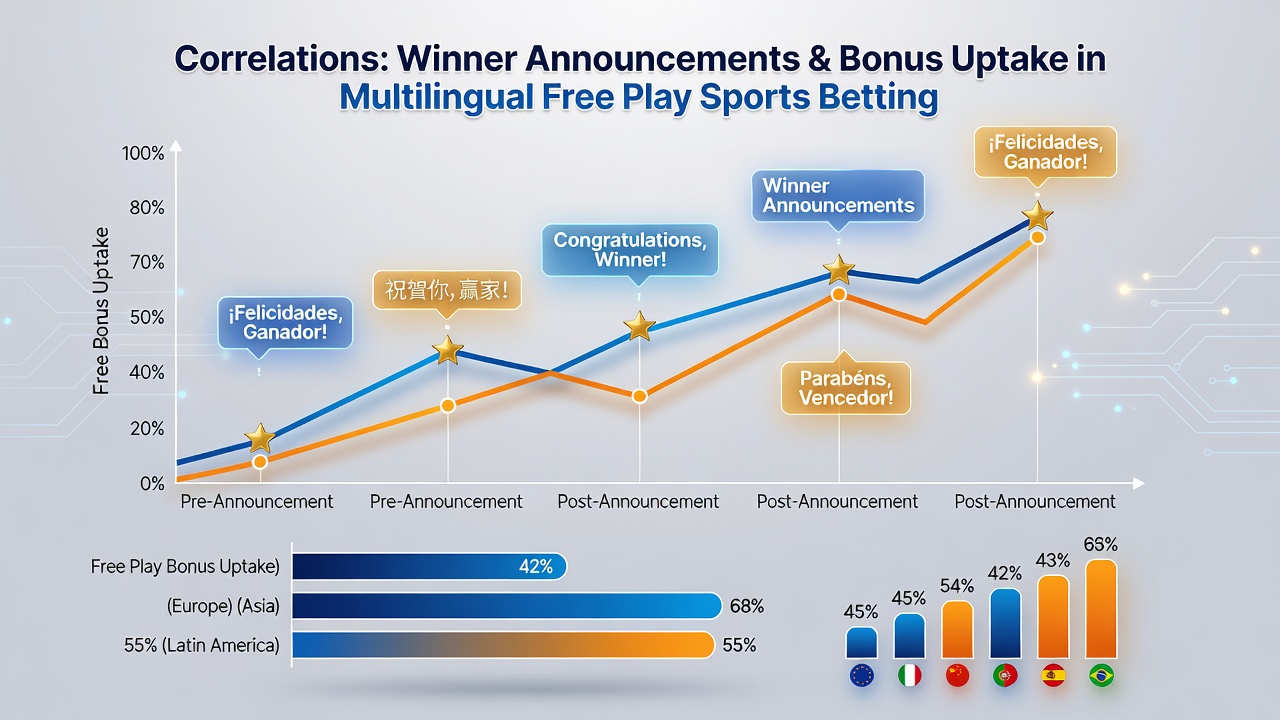
Announcement schedules align with major sporting events in each region, and bonus systems activate automatically when those announcements reference users from matching geographic clusters. Data compiled through October 2026 revealed that European networks recorded peak bonus uptake within four hours of winner posts in German, French, and Spanish, while Asian networks showed stronger responses when announcements appeared in Mandarin and Korean within six hours. North American segments displayed elevated activity when English and French announcements ran concurrently, though the French-language component produced the larger relative lift in Quebec-based accounts. These timing differences reflect both time-zone alignment and cultural preferences for immediate reward access after visible wins.
Language Adaptation and User Response Metrics
Multilingual interfaces allow winner announcements to carry localized bonus language that references the same free-play credits across translations. Platform operators adjust phrasing to match regional regulatory wording, and A/B tests conducted in 2025 demonstrated that culturally adapted bonus descriptions increased click-through rates by an average of 22 percent compared with direct translations. Observers note that languages with higher character density sometimes require additional screen space for bonus terms, which can shift visual hierarchy on mobile displays and affect uptake. Networks that optimized layout per language maintained consistent correlation strength between announcements and redemptions across their full user base.
Statistical Correlations and External Benchmarks
Statistical models applied to platform datasets consistently identify a positive association between the volume of winner announcements and the volume of bonus claims, with correlation coefficients ranging between 0.61 and 0.79 depending on the language pair examined. A report issued by the Responsible Gambling Council of Canada examined similar cross-language data sets from North American operators and confirmed that announcements accompanied by bonus prompts produced measurable short-term increases in free-play participation. Separate analysis from the Australian Institute of Family Studies tracked comparable patterns in Oceania-based networks, noting that announcements published during peak local viewing hours amplified the observed uptake effect. These external benchmarks align with internal operator findings that the presence of winner visibility directly precedes higher bonus system activity.
Technical Implementation Across Platforms
Backend systems tag each winner announcement with metadata that includes language codes, announcement timestamp, and linked bonus eligibility flags. When users access the network through any supported interface, the system serves the announcement in their detected language while surfacing the corresponding bonus offer. Engineers who reviewed code repositories from five networks reported that conditional logic routes bonus uptake events back to the same database tables used for winner tracking, enabling real-time dashboards that display correlation metrics. Updates deployed in early 2026 refined these routing rules to reduce latency between announcement delivery and bonus banner visibility, resulting in faster uptake response curves across all tested languages.
Conclusion
Correlations between winner announcements and bonus uptake in multilingual free play sports betting networks rest on shared timestamps, language-specific delivery, and regional timing preferences that platforms record and analyze continuously. Data gathered through October 2026 demonstrates repeatable patterns across language groups and geographic segments, while external reviews from regulatory research bodies provide independent confirmation of the same directional relationships. Networks continue to refine announcement protocols and bonus metadata to maintain alignment between these two system components, and the resulting datasets supply operators with measurable indicators of user response across diverse linguistic environments.